
Friday, January 29, 2016

Searching for a Reclusive Author


From A River of Stories Book


Notes from my journal about a trip I made to Tennessee:

Left in Jeep with the top down in July heat headed for Hohenwald, Tennessee. I hoped to meet and visit with author William Gay. I read his Provinces of Night and was mesmerized. When I saw a photo of the author beside a crude painted poster of Jimmie Rodgers, I knew there had to be some type of connection between us. I had heard he was somewhat reclusive, so my chances were doubtful. To give my pragmatic left brain an excuse for chasing such a wild goose, I told it that I was going to do some family history research. My maternal great grandparents came from Maury, Tennessee.
Spent first night in a real fleabag motel. A driving overnight rainstorm (6 inches) filled the Jeep floorboards overnight. Yes, I had a cover, but it just served as a funnel to pour water inside the Jeep. I pulled into a covered service station bay and managed to get the top up and Velcro the side windows in the pre-dawn dark.
Jeep windows fogged up quite a bit as the temp dropped about thirty degrees when I headed into the mountains. Discovered ballpoint pens had rolled off and blocked defroster.  Smoke boiled out of tall trees as temperature dropped. Road very winding, up and down and I was constantly threatened with log trucks, but held my own. Jeep handled well. Kudzu everywhere.  Must have crossed six or seven rivers including the Beech. Crossed the Tennessee River on Alvin York Bridge (hero of First World War) from Tennessee.  Over Coon Creek, Rushing Creek, etc…
Finally made it to Hohenwald and checked into only motel in town. Pretty crummy and worn out, but paradise compared to first night.  Took the precaution of examining the room before I gave up my credit card this time.  Also checked for ice machine, which was second only to cleanliness in importance.  Don’t need chocolates on my pillow, but I require ice. 
Next morning, I drove down to old house that had been converted into coffee shop/bookstore just off the square.  Looked for William Gay’s books and did not find a one. Asked owner about him and the guy turned up his nose and told me to ask his wife.  When I did, she just said, “He’s a hermit.”  They told me he had moved to another part of the county.  Hohenwald is in Lewis County (named for Explorer Meriwether Lewis, who is buried here).
Went to Chamber of Commerce and picked up some info. and maps.  Nice lady there said Gay comes to library quite often, but is reclusive and strange.  Of course, I already knew that from seeing pictures of him and from reading his stuff.  Made me want to meet him even more.  Said she would give my cell number to lady at library when she returned.  Maybe she could help. 
I drove up to Columbia, Tenn., county seat of Maury County, where my maternal grandmother was born. Had to almost strip and give up my pocket knife to get into courthouse where county clerk (called by different title there) seemed unfamiliar with the concept of marriage licenses and birth certificates.  Finally, someone told me that archives were kept in the old jail across the street.  Great old restored building and helpful people there.  Found marriage license for great grandparents. Their old farm is now a state park in Maury County and in Marshall County, (Lewisberg County Seat), Nathan Bedford Forrest (Civil War Hero) memorial is also on their old farm. Satisfied to have accomplished at least something, I headed back to Hohenwald, taking a little side trip on Natchez Trace Parkway.  Very, very, nice Jeep ride.  Close to Choctaw country and more ancestors. 
Back in Hohenwald, I learned it’s common practice to name roads for residents, so I located William Gay Road in late afternoon. Only one house on the road’s dead end.  Beware of dog and Trespassers will be Shot and Survivors Prosecuted signs.  Dogs would not let me get out and knock. They literally tried to chew the tires off my Jeep and tried to jump inside (the top was down), so I turned around and came back disappointed.  Wish I could have taken a picture, but camera was back in motel room.  The house was built with rough-hewn timber, not logs, and had several different types of rusted sheet metal on the roof.  Gay was a carpenter by trade, so I wondered if he had built it. Interesting place.  Would love to have seen the inside. I settled for a Jeep ride through Tennessee Hill Country and lucked on Grinders Creek, a place mentioned often in Gay’s novels. Looks just like he described in his book. 
The next day, I walked downtown to the chamber again and found that the librarian had called Gay on my behalf. The reclusive author told her that he might call me. Went to library and the librarian gave up his correct number (after I gave her one of my own books.)  I called.  He confirmed that he had tried to call me but lady had given him one digit wrong on number. Told me to drive on out to his house.  Seems his wife divorced him and took the house on William Gay Road. 
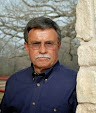
Followed his directions to Little Swan Creek. His house is up a slight hill just before the bridge that crosses the creek.  He shares a road with other folks that live up the hill behind him.  William Gay looks just like what he was most of his life, a drywall man who may have drunk and smoked a little too much.  However, this drywall man is brilliant.  Hair hangs in ringlets as if it had never seen a comb, over his collar but not as long as I have seen in pictures of him. 
House is logs with red metal roof.  Nice enough, but he has not abandoned his hillbilly heritage.  An abandoned pickup sits in front of a small shop, the bed full of V-8 cans and assorted trash.  Think he was sipping V-8 the whole time I talked to him, alternating with drags on cigarettes.  Said he and his son are trying to quit.  Interesting that I also consume a lot of V-8.  End of his left index finger has been pinched off.  Mine, too. 
Room filled with books. Hundreds. Fireplace and wood stove in the room, but no overhead light.  Room very dark (just like I like my office).  Paintings scattered here and there.  (Yes, he paints, too.)  A few guitars and a few books on how to compose music. Big books on Van Gogh art and lots of DVD’s and all kinds of art books. While he talked on phone to his daughter, I perused the shelves and found our tastes a lot alike, especially in movies.  (I offered to leave so he could talk in private, but he motioned for me to stay).
I kept offering to end my intrusion on his privacy, but he urged me to stay and talk. We talked about his writing and some funny stories.  I told him that the scene with Albright and the hog was the funniest I ever read. Asked him about characters in Provinces of Night, Fleming, E. W. and Boyd, etc… Told me he was a little bit Fleming (a seventeen year-old boy), a little bit Boyd (the boy’s father), and a little bit E. W. (the grandfather).  Same answer I give when people ask me if I am Jake in my books. 
He had a director’s chair with the name of his book of short stories on it. They made a movie recently based on one of the stories in Hate to see That Evening Sun Go Down. Hal Holbrook plays the old man. I have since seen the movie and really enjoyed it.  
He got a call from his agent while I was there about another book Twilight.  It has been optioned for a movie, also.  Don’t like it was well as Provinces, but still a very good read.  After my visit, I learned that Provinces would be made into a movie starring Kris Kristofferson called “Bloodworth”. I also learned that his publisher for The Lost Country is having trouble and holding up its publication.
I told him I had written him in the first part of 2007 after reading Provinces.  Said that was about the time his wife kicked him out and he never got the letter.  He seemed impressed that I brought along a copy.  He’s won numerous prestigious awards, primarily for his magazine short stories, but also for his books.  He’s a visiting writing scholar at Sewanee, University of the South.  Oxford-American magazine commissioned him to write an article about his experiences going to a college campus as a scholar when he never attended college.  He has read himself into brilliance.  Though I expect there was something genetic going on, too. 
A lady in town asked him if he got help with his writing.  He asked, “What kind of help?”
She said, “Well, your people was never very smart and you wasn’t either.  Figured you got some help.”
Based on his stories, his family was both poor and violent, doing everything wrong to the excess.  Although he had a huge appetite for books and magazines and regularly entered writing contests, he followed the same path as the rest of the family for most of his life until he started winning competitions for his stories.
I was a reader as a kid, but always felt guilty about it and never read any heavy stuff unless I had to. Wish someone had told me reading was never a waste of time. I recall reading a comic book (we called them funny books) when Daddy ran a service station in Commerce.  I was about ten and was supposed to watch the front while daddy did some mechanic work in the garage behind. A customer went to get him because he could not get my attention to take his money. Daddy had to shake me I was so engrossed in reading what was probably a comic book.  Don’t think that has happened before or since, but I get the impression that William Gay lived his life inside books because his outside life was so bad. 
I praised him for the dialect in his writing because I consider it perfect. He said he listened to folks around there a lot.  Recently, a man on a construction job complained, “My old lady ain’t put a hot meal on the table in weeks. The bitch will be laying on her ass when I get home tonight.”  When asked what he would do if he she did have a hot meal, he replied.  “I won’t eat a damn bite.”  I found that hilarious and so typical. 
I told him I had met Flannery O’Connor once when she came to ET. He asked which year and I said 62 or 63. I think he was trying to catch me in a made-up story, because he knew that she died in 64 at 39. He asked if she was frail when I saw her. He said he had always wanted to meet her. He told me of many writers who had influenced his writing and life, including a fellow who wrote stories for the Progressive Farmer magazine.  Gay has an incredible memory for authors and book titles. Wish I did. I can remember details inside books, but have trouble with titles and authors.
I left after a couple of hours and drove up the Natchez Trace toward Nashville. Got off a little early and headed toward Grinders Switch (home of Minnie Pearl).  There is a water tower and an abandoned depot, but little else there.  Really great Jeep riding though the winding hills and across winding railroad track.  Back down through pretty mountain scenery and to Hohenwald by bedtime. A good day.
William Gay
William Gay
William Gay first came to the Sewanee Writers Conference in 1999 as a Tennessee Williams Scholar. Later that year, Gay published his first novel, The Long Home, which received the James A. Michener Memorial Prize. Gay returned to Sewanee in 2000 as a Walter A. Dakin Fellow and served as the Tennessee Williams Fellow for the 2000-2001 academic year. Gay then published another novel, Provinces of Night, and a collection of stories, I Hate to See That Evening Sun Go Down, which contained stories that had been published in the Missouri Review, Georgia Review, Oxford American, Atlantic Monthly, and Harper's. His stories have also been anthologized in Best American Short Stories, New Stories from the South, O. Henry Awards Prize Stories, Best New American Voices, and Best American Mystery Stories. In 2006, he published his third novel, Twilight, and was named a USA Ford Foundation Fellow by United States Artists. *In 2010, MacAdam/Cage will publish his new novel, The Lost Country.
*Note: Gay died before his last novel was published. Nobody has found his last manuscript (or will admit to it.)


Friday, January 15, 2016

The Fellowship--The Literary Lives of the Inklings


 Listen to KETR Podcast interview here

I have quoted C. S. Lewis many times in books and other writings and have always been fascinated by his conversion from atheism to Christianity. His book Mere Christianity had a profound effect on my life. It still astounds me that the man could write such diverse books as the Chronicles of Narnia series, Surprised by Joy, and The Screwtape Letters, thirty books in all.  I also found the movie Shadowlands, with Anthony Hopkins playing Lewis, fascinating. Lewis, at one time, was one of the most famous people on the planet and remains one of the most widely quoted Christian apologists today. 

I learned later about the relationship between Lewis and J.R.R. Tolkien of Lord of the Rings fame and how Tolkien (a devout Catholic) influenced Lewis’s conversion. Though Tolkien influenced Lewis’s conversion, I did not know that Lewis, in the early days, held an anti-Catholic bias based on his Irish upbringing.  

I thought of both men as brilliant scholars, but mostly writers of fantasy tales meant primarily for children. How wrong I was. I learned that they combined their voluminous learning with a strong liking for fantasy—fantasy not indulged independently of their ideas, but about their ideas.
The book tells the story of the Inklings, a group of writers, professors, scholars, academics and various other possessors of titles both honorary and practiced who met regularly to engage in deep discussions of religion, spirituality, fantasy, the meaning of life, poetry, and other deep intellectual topics too many to list here. I imagine the rooms where they met literally expanding and contracting with the IQ’s of the brilliant folks mentioned in this book. It focuses on Lewis, Tolkien, Barfield and Williams, but many, many others were involved as part of the group or peripherally, names like Saul Bellow, T. S. Eliot, Dorothy L. Sayers, etc.

The authors delve deeply into the Inkling members’ meetings as well as their personal lives and interactions. Although I think it would have been a better book at 350 or so pages rather than 500, who am I, an intellectual lightweight compared to these giant brains, to know? I had to keep a dictionary handy to wade through the multitude of terms regarding philosophical and scholastic studies and disciplines.

I believe it is safe to say that the group unleashed a mythic awakening and a Christian awakening that surpasses anything or anyone else in the 20th century. Without them, there would probably have never been a Dungeons and Dragons, or Harry Potter. 

I confess that I drew as much inspiration from the weaknesses exposed in this book as I did from the strengths and triumphs of these literary icons. I knew about Lewis’s strange relationship with Mrs. Moore , but not as much about his hearty appetite for drink and ribaldry. It was fascinating to learn that even the most brilliant minds can suffer from the same pettiness and daily problems that the rest of us do. They Inklings argued among themselves, hurt each other with their criticisms and reviews of each other’s works, suffered from envy. They endured failures as well as triumphs. I think the authors best describe their own work with this:
“By returning to the fundamentals of story and exploring its relation to faith, virtue, self-transcendence, and hope, the Inklings have renewed a current that runs through the heart of Western literature.”

Tuesday, January 12, 2016

Teaching personal finance to high school students

Long-time certified financial planner Jim Ainsworth agrees with states that require high-school students to take at least one class in personal finance.  A recent survey reports that U.S. teenagers were in the lower half of the 18 countries in the study on financial knowledge, behind Russia and China.

Listen here

Wednesday, November 4, 2015

A New Review for Rails to a River

A literary work of fiction with a lot of heart
November 4, 2015
This review is from: Rails to a River: A Long Awakening (Kindle Edition)
There are great storytellers and literary storytellers across this land. Jim Ainsworth is both. In Rails to a River, as in his other novels, Jim is a sculptor who carves the right words from our language and strings them together with the beauty of a poet and the sudden impact of a pistol shot.
Just read a brief passage, and you will understand immediately what I am talking about: “But not even Father Bob can explain why Tee was spared, why it seems as if he has been plucked by some malevolent force from a life he understood and loved and set down into a suit and tie existence in, a world college professors called a corporate culture. The old priest could not explain why two events, sixty-seven days apart, five hundred miles apart, shattered Tee’s hopes, rudely maneuvered his life down a road he did not want to travel toward a place he does not want to be.”

Jim Ainsworth understands the storms that threaten to destroy men like Tee Jessup, that leave Tee adrift in a world that views him as a man who doesn’t belong. A single moment of time has changed his life forever. He probably should not have survived the accident at a remote railroad crossing. He probably should not have awakened from the coma. It might have been better if he hadn’t. All that he loved has been stolen from him
He had always been at home in the wide-open spaces of a West Texas ranch. His home is gone. He drives away from the ranch. He heads to the city. He heads to the great unknown. He is a man most miserable, a stranger in a strange place. He works. He fails. His wife leaves him. She takes his son. He assumes it’s because he has become a failure. Her reasons are far more sinister. But what are they?

Tee faces a journey he does not want to take and searches for those stolen moments of his life that he may never find. It is a journey that the reader takes right along step-by-step with Tee Jessup as he travels a long, winding, and unfamiliar road. When Tee is lost, we are lost. When Tee hurts, we feel his pain. Tee Jessup is no longer a stranger. He’s a friend. He’s family. Jim Ainsworth has the rare ability to make sure of it. Jim writes about the West, but Rails to a River is not a Western. Tee is entangled with the mysteries that surround his life, but Rails to a River is not a mystery. Tee searches for the love he has lost – the love of the woman and his love for the land – but Rails to the River is not a romance. It’s life.

If you want to read a literary work of fiction with a great story that has a lot of heart, read Jim Ainsworth. It’s life as only one man has lived it, life as only Jim Ainsworth can write it.

Tuesday, September 29, 2015

Optimism, Vigilance, and Trump


Please take a look at these short articles by Alexander Green:  

Here is my response:

Dear Alex,
In your recent articles about Donald Trump and the American economy, you seem to indicate that we are on the right path and most things are hunky-dory. Your only qualifier was your dissatisfaction with some of the “shenanigans” going on in DC. Shenanigans seems a pretty weak description.

I have read your books and given them as gifts. But these articles overlook or gloss over some very important facts and present a Utopian view of what’s happening in our country. 
 
You challenged your readers to refute any of your “facts” and stated we should “put on our dome-shaped hats and go stand in the corner” if we did. You expressed astonishment at how many of us dunces “cannot tell the difference between fact and opinion”. Pretty harsh and, I think, wrong.

I mostly agree with you on the Donald, though I am not sure you understand why he is so popular. I think conservatives are sick of Republicans’ “rollover and play dead” strategy and surrendering without a fight to Obama. And we are sick of political correctness and the whiners who constantly look for some word or phrase to offend them. It’s keeping us from discussing important issues facing this country. 
Let’s take your facts one at a time:

The dollar is the world’s reserve currency.

Correct, but it is under attack from China and there is the possibility, however remote, that situation could change. Some experts believe it is China’s intent to displace the buck.

The US military is the primary defender of the free world.

Correct, but our ability to continue in that role has been severely diminished during the Obama administration. Our military is now at pre-WW II levels, and in some cases, WW I levels. Real warrior leaders have been replaced with politically correct ones who toe the White House line.

We now face the largest mass migration since the days of Hitler and possibly in world history.

We have just negotiated (one can hardly describe what the inept Obama/Kerry and their minions did as negotiation—capitulation is a better description) an egregious, arrogant, and dangerous agreement with the world’s leading sponsor of terrorism. And we got virtually nothing in return.

China, Russia, and Iran appear to be moving to squeeze us out of Europe and the Middle East and Putin is clearly trying to splinter NATO. Russia has taken over Crimea, is in the process of taking Ukraine, is building military bases in Syria, and sold defensive weapons to Iran to limit our military options.
And then there is China with its cyber attacks, building islands in the South China Sea, buying up our debt.

Our allies no longer trust us and our enemies no longer respect us. And let’s not forget North Korea, with nukes we paid for. And what about our inept attempts to defeat ISIS?

Our banks have never been stronger.

Many pundits said the same thing just before the 2008 crisis. You name only big banks in your analysis, without mentioning the negative impact of Dodd-Frank on community banks. None have been started since 2011. And many big banks took huge chunks of bailout money from taxpayers. 

The U.S. economy grew at 3.7% in the most recent quarter. That’s twice the rate of growth in Europe and four times that of Japan.

Have you noticed that the numbers we are fed on GDP are often revised downward with little mention in the press? And 3.7% is not all that strong after seven years of tepid growth and certainly not strong enough to handle our enormous debt. Comparing it to the dismal numbers of Europe and Japan seems to prove nothing except that those two nations are in deep economic turmoil. And aren’t their weak economies bad news for America, too?

Unemployment is at a seven year low.

The U-3 measure of unemployment is meaningless. The press should be ashamed for ever quoting it. U-3 does not count folks who have quit looking for a job (given up) in the four weeks before the data are compiled. How does one determine if a person has given up? Answer: you can’t. Is he still unemployed? Answer: yes. The U-6 measure is more accurate and is still above 10%.

An even more important number is the labor participation rate. It’s at a four decade low. Almost 40% of our workforce is not working. The number of people dependent on the government for subsistence (welfare, food stamps, etc.) is at an all time high and growing at an unsustainable rate.

The federal deficit as a percentage of GDP is at its lowest level in eight years.

That is a one-year statistic. I assume you know that the deficit measures the excess of expenses over revenues for a single fiscal year. Comparing it to GDP during a period begun when we were mired in a deep recession makes it virtually meaningless and certainly nothing to boast about.

The important number is the total debt. I’m one of those old-fashioned accountants that measures debt by our ability to pay it off.  We’re close to $19 trillion now—an all-time high. This president has now run up more debt than all other presidents combined.

Debt has a tipping point. Ask Donald Trump. He had four corporations to pass that tipping point. 
And what about our unfunded liabilities? Many economists say they are close to $180 trillion. That’s about $1.5 trillion per taxpayer. Nobody really knows because the government does not book such debts as liabilities. But they still have to be paid.

Since the 2008 financial crisis, stocks have nearly tripled.  

There you go again, using historical lows to measure gains. When you start low, it is easy to garner some impressive stats. I will grant you that the stock market has performed well (until recently). I am still invested. I used to tell my clients that I am always right about the markets, I just may be off by a decade or two, or three.

Why am I invested when I see America headed in the wrong direction? Because it is the only place where one has the best chance of generating income. Investors are forced to take risks they would rather not take during retirement years because our central bank has kept interest rates at historic lows and effectively taken away most investment options other than the stock market.  

I also believe that the market is no longer primarily driven by fundamentals. It is driven by interest rates and high-frequency trading. The days of studying a company’s financials, its history, its products or services, its place in the industry, and its management can be screwed up by a few wet-behind-the-ears stock jockeys who are more interested in where the stock is going in the next thirty seconds than in the next five years. Don’t believe that? How else can you explain the panic caused when the Fed mentions a mere quarter point rise in rates?

Perhaps when you a little older with a shorter time horizon, you will better understand those of us (as well as many Trump supporters) who want to change the direction of our country now, not ten years down the road. We’re tired of political elites who seem to believe that you must control both the White House and Congress to get anything done. History belies that silly notion.

Educational attainment in the country has never been higher.

I am not sure how one would go about measuring that and am not sure even of the definition. However, I am deeply concerned about what our young people are being taught in schools and colleges. Think socialism, class warfare, and forced income redistribution. And SAT scores are on a steady decline.

There are no class distinctions or caste systems to hold citizens back from economic success.

Using the eight years you like to compare, class and race divisions have taken a radical turn for the worse.

Americans have never been richer. Last week, the Federal Reserve reported that U. S. household net worth hit another all-time record of $85.7 trillion.

Ah yes, the ultra-secretive, unaudited Fed again. Having prepared hundreds of personal financial statement for clients, I know it can be a laborious process. How does the Fed know, for example, my net worth? I know technology has changed the world, but hopefully, some things are still secret.  Also, even if net worth is at an all time high, average income for the middle class is down.

In 2013, the U. S surpassed Russia to become the world’s largest oil and gas producer.  

That is definitely good news. However, because of the government, we still have restrictions on our ability to take full advantage. We have restrictions on finding, transporting (Keystone?) and exporting energy to compete with OPEC and Russia and take our earned place as an energy superpower.

Inflation is negligible.

How about those billions of dollars the Fed injected into the economy? Will that increase the money supply? Isn’t one of the indicators of inflation too many dollars chasing too few goods?

And the way we measure inflation has been changed so often that the reported stats are no longer trustworthy (they no longer includes "luxuries" like food or fuel, for example, because they keep showing pesky increases). If something we buy goes up too much to satisfy their politics, the bureaucrats just take it out of the equation.  For example, the battery in my Jeep failed recently. I bought it six years ago for $69 with a six year warranty. The replacement battery cost $140 with a three year warranty. That’s 34% per year increase for half the battery life. Is that inflation? And if you think that’s an anomaly, better think again. Inflation is when things go up, and virtually everything I buy has gone up by 8-10% per year for a decade.

Gold has spent the last four years looking like the last flight of the Hindenberg.

Using your own analogies about the future of stocks, wouldn’t that be a strong indicator to buy gold?

And then, finally, you quote two technology gurus (your description) and they say:
Violence is at an all time low and personal freedoms at a historic high.

“All time” indicates forever, I suppose, but are they talking about America or the world? The Economic Freedom Index shows America on a steady decline, dropping to number twelve. Even Canada and Chile surpass us. And violence—tell that to people in Chicago and most of America’s largest cities.

Groceries cost thirteen times less today than in 1870.

1870? Really? Is that a meaningful stat? How about compared to 2008? Been shopping lately?

Poverty has declined more in the last fifty years than in the previous 500.

Poverty has increased in the last fifty years, not declined, largely due to the War on Poverty. And were we keeping poverty records in 1515? And if we were, wouldn’t most people be considered poverty-stricken by today’s measures?

I suppose your article garnered so much attention because Donald Trump was in the title and you tried to discredit his negative views on the economy. Trump is a product of John Boehner, Mitch McConnell, Barack Obama, political correctness, and what an open border policy is doing to our great country. Americans are hungry for anyone who will speak truth to power and be willing to take the slings and arrows sure to come their way (Trump, apparently can dish it out but can’t take it).

If you are giving advice to Trump supporters, you would have been better off to mention that he believes single payer healthcare works when it clearly does not, or that he was in favor of the disastrous 2008 bailout. Or maybe you could highlight the four corporate bankruptcies.  A lot of very competent people have declared personal bankruptcy or headed corporations that declared it. But four times in the same industry?

Trump even boasts about his timing and expertise in taking advantage of bankruptcy laws while employees and debtors took it in the shorts. Only a narcissist would boast about that, and we have had a narcissist as president. How’s that working out? Narcissism is a dangerous trait for the leader of anything.

Statistics are strange things. Much of what I stated here is my interpretation of stats or facts. The difference is that I admit it. You did not. You stated unequivocally that your statements were facts, when in many cases they were your interpretations of facts.

I applaud your optimism, but it seems to suggest complacence. If Thomas Jefferson did not say, “The price of liberty is eternal vigilance”, he should have. Many of us like a little vigilance mixed with our optimism. Or maybe you were just "drinking that sweet bubble-up and eating that rainbow stew".

Tuesday, September 22, 2015

Try Me, Lord


During twenty-plus years of writing, the question of “Why?” comes up pretty often. Folks understand the business books I wrote in the beginning, but friends don’t understand why a guy who spent most of his career dealing in numbers would decide to try his hand at novels. 

Most of the time, I ask that question of myself. I have tried ad nauseam to explain to myself why I write. As Clayton Delaney told his young protégé Tom T. Hall about a career in music, “Ain’t no money in it. It’ll lead you to an early grave.”  

I have written quite a bit about my admiration for songwriters. They can tell a story in a single page that often takes a novelist a whole book to tell. One of my favorite songwriters is Kris Kristofferson. He can’t sing too well and is a mediocre actor, but he is one heck of a songwriter. 

Who doesn’t hum when someone mentions Help Me Make It Through the Night, or Sunday Mornin’ Coming Down, For the Good Times, or Me and Bobby McGee? What most don’t know is that his best- selling song was Why Me, commonly known as Why Me, Lord?. 

I could sing along with most of the lyrics to the song, but I never really paid much attention to the meaning of the words until about a year ago. I don’t remember why or exactly when I began to concentrate on the lyrics and their meaning. All I know is that usually means I was just meant to do that. 
I focused on these:
Try me, Lord, if you think there's a way
I can try to repay all I've taken from you
Maybe Lord, I can show someone else
What I've been through myself, on my way back to you

If that isn’t a good description for why I write, well, I don’t know what is. I focused on those words as I wrote the Believing in a Grand Thing section in A River of Stories. I have used the lyrics in a few presentations to writers and readers.

One recent Sunday morning (coming down?) wife Jan brought out her smart phone to the deck and showed me a video of the story behind the song. Someone had posted it on her Facebook page. It brought tears to my eyes as I heard Kris tell the story. Made me wonder why I did not look it up before. It’s short, so you can watch it here

Then, a week or so later, we attended a Festival at the Caney Creek Cowboy Church near Grand Saline. Old friend Don Edwards was performing.  Those of you who read A River of Stories may remember the tale of The Bard and the Balladeer. Don, of course, is the Balladeer. 

Guess what his second song was at Caney Creek? I had never heard him sing Why Me, Lord before. Sorry Kris, but his rendition is better than yours. After Don’s performance, I told him that he needed to outlive me, so he could sing that song at my funeral.

I love it when God winks.